
The Values on a Washington County Property Record
A Washington County assessment record carries several distinct numbers. You may find a market estimate, taxable value, land and improvement components, exemption status, and the tax-year context on the card. Displays vary by account and online view. Read the year and the field label before assuming every property card shows the same things. The Assessor values property for ad valorem taxation. The Treasurer applies rates and collects the bill. A recorded deed supplies transfer information, but its consideration is not automatically the present value.
| Value | What It Is | Where |
|---|---|---|
| Market value estimate | The Assessor's estimate for the applicable roll year, subject to its valuation process | Assessor parcel record |
| Taxable value | Value used in the tax calculation after any applicable exemption or taxable-value adjustment | Assessor record and tax notice |
| Last sale price | Consideration reported for a recorded transfer, if available; it describes that transaction | Recorder deed and parcel history |
| Land and improvements | Components that help explain the assessment allocation for land and buildings | Assessor parcel record |
Utah's residential exemption reduces the taxable value of a qualifying primary residence by 45 percent from market value. The remaining 55 percent stays taxable. That does not make the market estimate 45 percent of the home's worth. The Assessor still values the property at market. A vacation cabin or rental may not qualify. Ownership, occupancy, application status, and statutory eligibility control the result. Check the actual account, and contact the Assessor if the exemption flag appears wrong.
Looking Up a Washington County Property Value
The Washington County Assessor's property search finds a parcel by situs address or tax ID. An address search may return several units. Pick the matching parcel and verify its situs location. Then read the assessment year alongside the market and taxable-value fields. The parcel map helps when a street address is ambiguous. Maps are especially useful where a parcel carries multiple building numbers or a rural route. They also help with a recently changed lot configuration.
- Search the property address or tax ID through the county Assessor portal; use the parcel map if the address returns several accounts.
- Record the value year and distinguish market estimate, taxable value, exemption, and land/improvement fields as labeled on that card.
- Review the recorded deed or transfer history for the last reported sale, including the instrument date and legal description.
- Compare relevant nearby parcels only after checking property type, location, lot size, improvements, and assessment year.
- Keep the tax notice and appeal dates if the question concerns a disputed current-year value.
- Market value
- The Assessor's estimate of market value for the roll's valuation date and tax year.
- Taxable value
- The portion of value subject to tax after exemptions and applicable adjustments.
- Primary residence exemption
- Utah's qualifying residential exemption reduces taxable value by 45 percent; verify eligibility and account status.
Washington County Valuation Dates and Annual Notices
Utah sets January 1 as the valuation date for each tax year. That date matters when you compare a notice against a later sale, remodel, or market shift. A change recorded after January 1 may not show up in the same roll. An assessment can also move because the county reviewed property characteristics. It is not because of a recent deed alone. Keep the notice year, value date, parcel number, and any supporting sale date together when you review the record.
The Assessor's office values property and maintains assessment information. It does not collect the annual bill. The Treasurer's BillTrax portal handles tax bills and payment history. An assessed value and a tax amount are linked through the levy and exemption rules. But a change to one is not a dollar-for-dollar change in the other. Taxing districts and rates affect the bill independently of the property's market estimate.
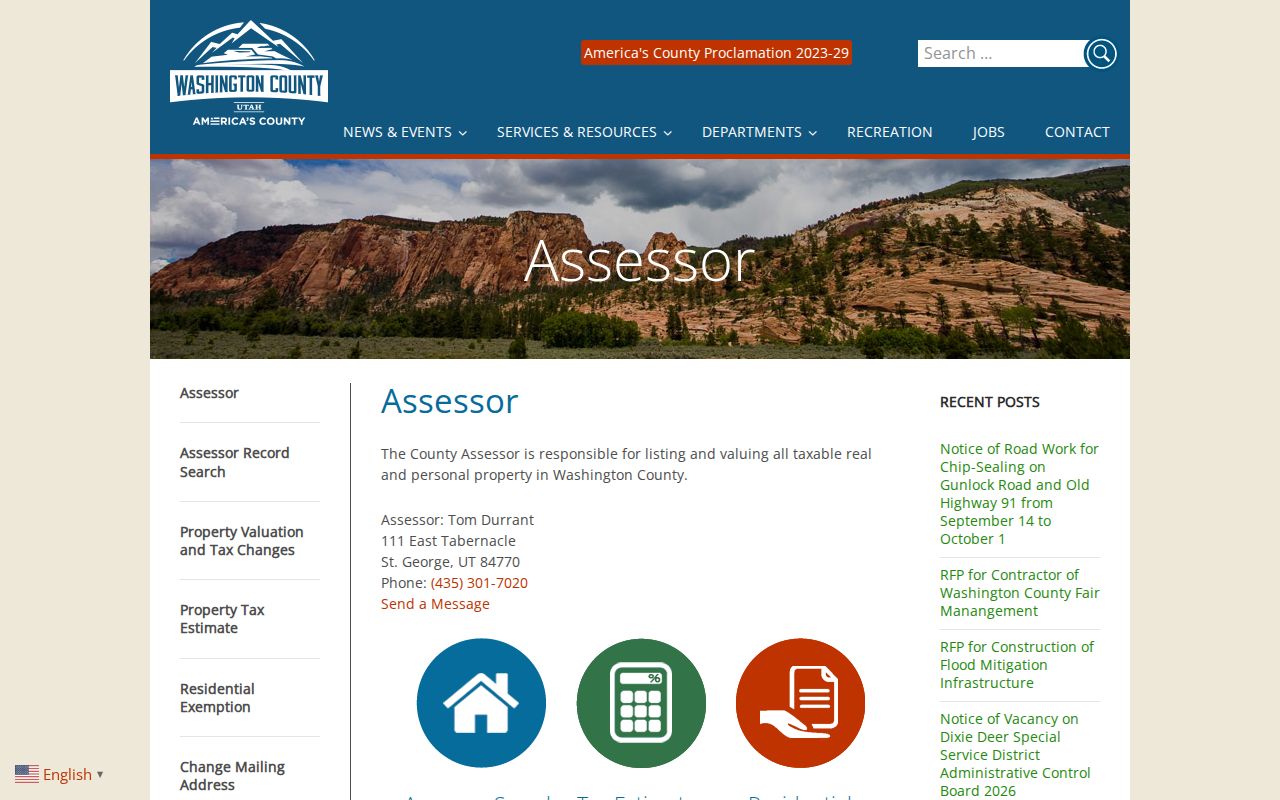
The county Assessor's responsibility and valuation page explains the office's duties. It also holds current valuation information.
Ask the Assessor which value field applies when the online record is unclear. Also ask whether the account shows a primary-residence exemption. Skip the neighbor's value as a shortcut comparison. Condition, acreage, access, zoning, and water rights may differ. Use comparable properties as evidence only when the facts and valuation date line up.
Compare a Recorded Value With Sales and Parcel Context
A recorded transfer can supply a useful market reference. Read the instrument first. The deed's price may describe a family transfer, partial interest, multi-parcel conveyance, or unusual terms rather than an arm's-length sale. Check the date, parties, and legal description. One deed may convey several parcels. Do not attribute its full consideration to a single account without support. The Recorder index documents instruments. The Assessor determines the tax valuation.
Open the county GIS Viewer for parcel shape, acreage, city limits, zoning, flood data, and aerial context. Historic layers and aerial photos can explain a prior subdivision. They do not provide an appraisal, prove condition, or fix a legal boundary. If the account holds a large undeveloped area, compare it with similar-use parcels that share legal access rather than a nearby house on a small lot.
Compare systematically. Note the current account's use class, improvement description, lot size, neighborhood, exemption status, and valuation year. Capture the same fields for each comparison parcel. Use the same tax year too. A taxable-value gap can come from an exemption, not from market value. A total-tax gap may reflect district rates, special assessments, or unpaid balances rather than a wrong assessment.
For a documented sale history, use the Recorder's public index and request a copy of the relevant instrument. The Assessor's parcel search and the Recorder's deed search answer complementary questions. Neither certifies market value by itself. The county's GIS Viewer adds parcel context, and the detailed Washington County deed records guide explains the instrument trail.
When to Appeal a Washington County Property Value
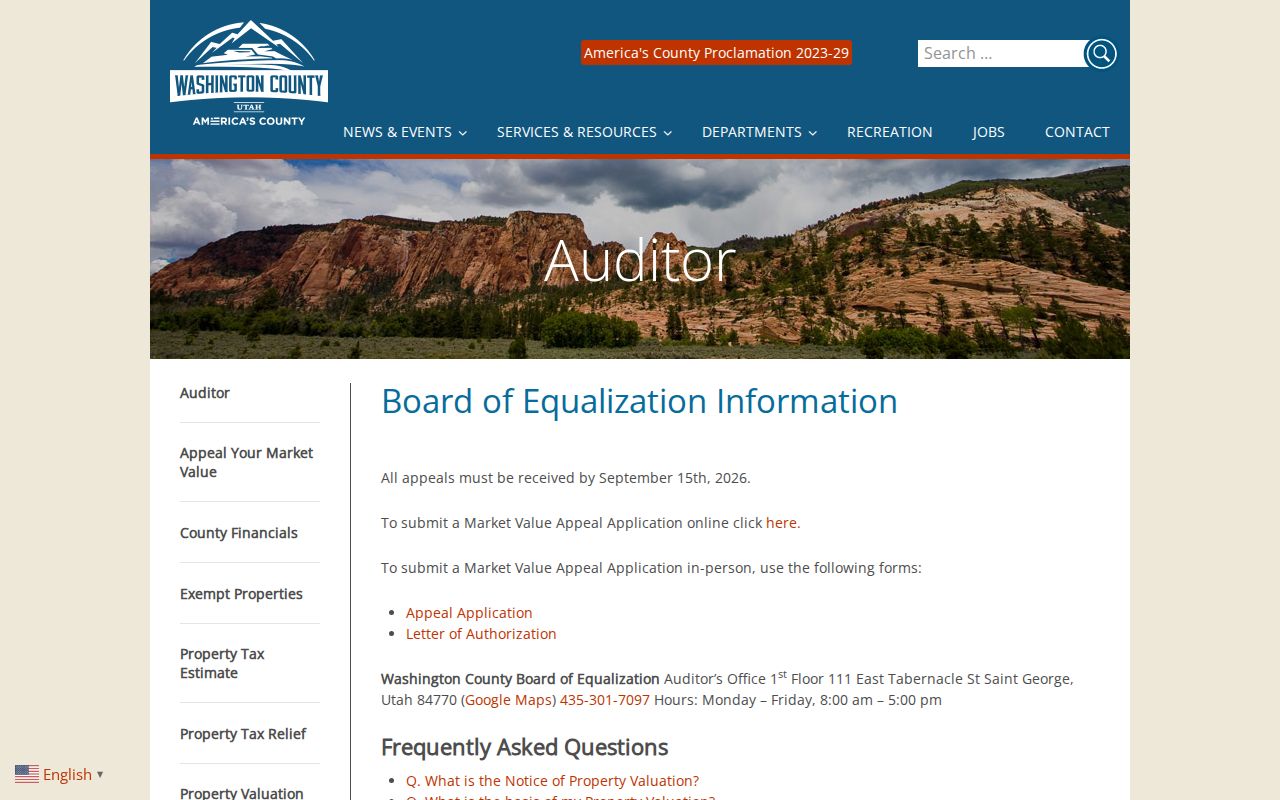
Start each appeal with the annual valuation notice. Check every field. Confirm the parcel number, owner of record, valuation year, market value, exemption, and address. Mistakes on the notice are worth catching early. Washington County's published 2026 schedule sets the valuation notice for July 22 and the county appeal deadline for September 15, 2026, though those calendar dates shift each year, so verify the current notice and the Board of Equalization page before filing. A late filing can be refused even while the owner is still gathering evidence.
The appeal itself goes to the Board of Equalization. It asks the board to review the market value placed on the parcel. Bring comparable sales near the January 1 valuation date. Include parcel and building facts, photographs or invoices documenting condition, a deed or listing detail for relevant transactions, and a short explanation connecting each item to the assessment. Tax amount alone is not the board's question. Keep proof of delivery.
The County Auditor administers the Board of Equalization. The county's appeal page publishes the application and filing instructions. It distinguishes market value from taxable value.
A county decision is not always the last word. Utah's Tax Commission route uses form TC-194. File it within 30 days of that decision. The decision letter and current state instructions control the exact filing requirements. A value appeal is also distinct from a title dispute, and ownership questions belong with recorded instruments and the proper legal process.
Property Value, Tax Bill, and Exemption Are Separate Questions
A property's bill combines taxable value with the rates its taxing entities impose. Washington County GIS maps tax districts. District boundaries can cross a neighborhood. Two nearby homes with similar market estimates may therefore carry different bills. A value appeal challenges the valuation. A payment-history or delinquency question belongs with the Treasurer. BillTrax shows bill and payment information, while the Assessor's record shows valuation and exemption fields.
Washington County gives qualified primary residences a 45 percent taxable-value reduction. Confirm the account has the correct status. Also confirm that the property meets eligibility requirements. A second home, rental, commercial use, or unverified application may not receive that reduction. Do not infer exemption eligibility from what a neighbor reports. Do not infer it from the tax amount on a listing.
For a property-value question the public card does not answer, contact the Assessor at 435-301-7020. For the bill or payment history, contact the Treasurer at 435-301-7720. A specific record not online can be requested from the responsible custodian under Utah's Government Records Access and Management Act (GRAMA). The request is subject to access rules and any lawful charge.
What a Washington County Assessor Value Is Not
An Assessor value is a mass-appraisal estimate for taxation. It reflects the applicable valuation date, not the market of the moment. It is not an offer, a guaranteed sale price, a lender's appraisal, or a title opinion. Gaps can still merit review. A recent market shift, a unique feature, or a corrected parcel description can each create one. A licensed appraiser can give an independent opinion for a sale or loan. That report does not replace the county's assessment. Use the right record and appeal channel.
Value vs price. The county assessment is a tax valuation for its stated roll year, not a promised sale price or lending appraisal. For a transaction or loan, rely on an appropriately scoped appraisal and the lender's requirements.